FLEAM DYKE – The Wildlife Trust for Bedfordshire, Cambridgeshire and Northamptonshire
Overview
The Fleam Dyke Habitat Bank project, led by the Wildlife Trust for Bedfordshire, Cambridgeshire & Northamptonshire (WTBCN), is a pioneering initiative to restore and enhance one of Cambridgeshire’s most significant historic and ecological landscapes. Part-funded by the Cambridgeshire and Peterborough Fund for Nature, the project aims to create and manage species-rich chalk grassland while supporting the long-term conservation of the Fleam Dyke Scheduled Monument and Site of Special Scientific Interest (SSSI).
Project Background
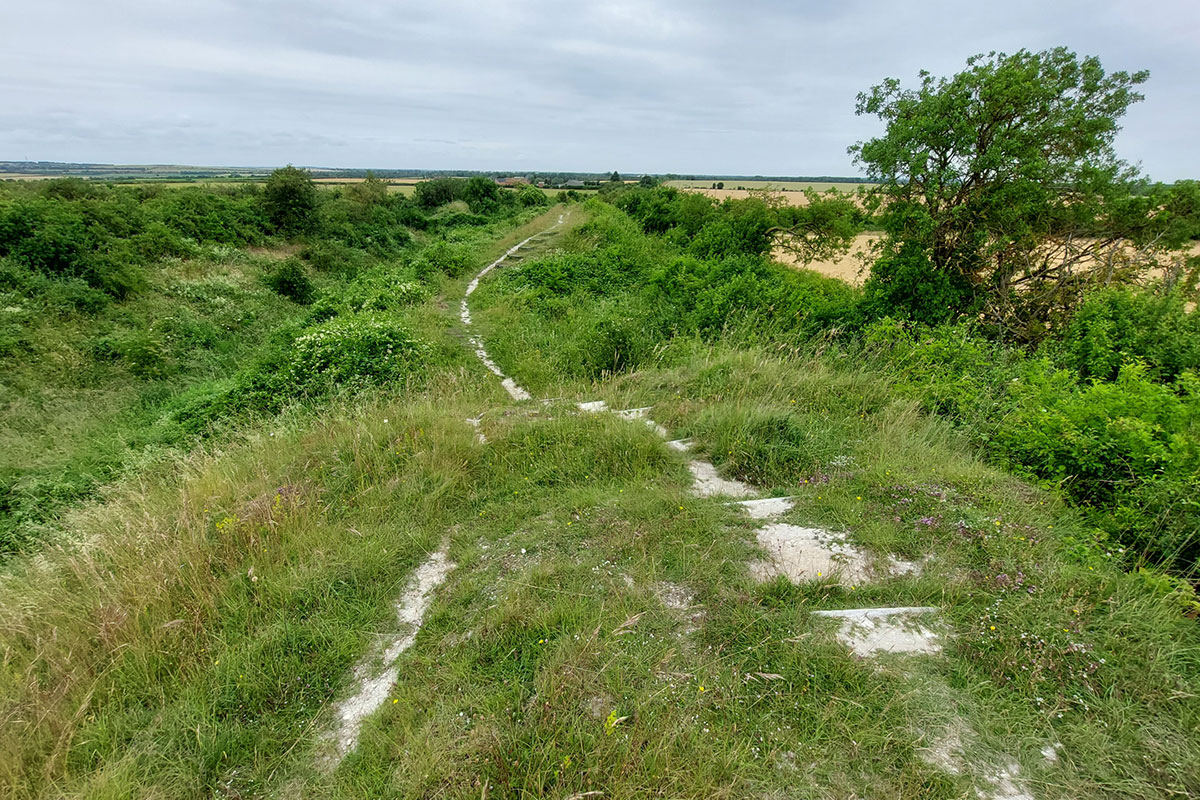
Fleam Dyke is a 3-mile-long Anglo-Saxon earthwork located between Fulbourn and Balsham. It is both a scheduled monument and a biological SSSI, known for its flower-rich chalk grassland and cultural significance. The project aligns with the broader ambition to Double Nature in Cambridgeshire, enhancing biodiversity and ecosystem services across the region.
In 2023, WTBCN acquired 7.59 hectares of adjacent arable land to establish a Habitat Bank. This land is being restored to calcareous grassland to generate Biodiversity Units for sale under the Biodiversity Net Gain (BNG) framework, providing a sustainable funding stream for the ongoing management of Fleam Dyke.
Key Objectives
- Restore 2.58 ha of Fleam Dyke SSSI through scrub clearance and conservation grazing.
- Create 7.59 ha of new species-rich grassland on adjacent arable land.
- Establish infrastructure (fencing, gates, water supply) to support grazing.
- Generate and sell Biodiversity Units to fund long-term site management.
- Involve volunteers in habitat management and biological monitoring.
Progress and Implementation
The arable land was acquired in 2023 and sown with a native wildflower and grass seed mix in October 2024. Monitoring in July 2025 showed promising establishment, with between 20 and 23 of the 30 sown chalk grassland species recorded in each of the four fields.
Fencing was installed over winter 2024/25. A water supply plan has been developed and agreed with Cambridge Water.
The fields were topped in late summer 2025 to suppress undesirable species and encourage the spread of target species and the plan is to commence grazing in 2026 to manage the vegetation and promote a rich array of chalk grassland plants.
On Fleam Dyke SSSI, the initial scrub clearance has been undertaken but will need to continue over the next 10 -20 years. Grazing will be re-introduced to part of the site, and the areas grazed will be extended as and when scrub clearance allows. Movement of livestock between the ancient grasslands on Fleam Dyke and the adjacent habitat creation site will help with seed dispersal and the spread of the rare chalk grassland plants.
Outcomes and Benefits
The project is delivering a range of positive outcomes across biodiversity, ecosystem services, innovation, and long-term sustainability. It contributes meaningfully to both the quantitative and qualitative targets of the Doubling Nature initiative by creating priority habitats and restoring degraded Sites of Special Scientific Interest (SSSI) land.
Grazing using local livestock will support a local farm business and contribute local food. The chalk grassland flowers will support pollinating insects and host insect predators which will help control pest in adjacent crops. The conversion of arable land to species-rich chalk grassland will improve soil health and build up soil carbon. The creation of chalk grassland adjacent to the ancient monument will restore its setting and contribute towards a more attractive environment.
Finally, the project’s sustainability is underpinned by the Habitat Bank model, which aims to secure long-term funding through the sale of Biodiversity Units. This approach reduces reliance on traditional grant funding and supports ongoing habitat management and enhancement. The aim is to commence marketing of the habitat bank and to seek the first sales of biodiversity units in 2026.
Conclusion
The Fleam Dyke project demonstrates how nature recovery, heritage conservation, and innovative funding mechanisms can work hand-in-hand. By restoring a nationally important site and creating new habitats, the Wildlife Trust BCN is not only enhancing biodiversity but also setting a model for sustainable land management.